
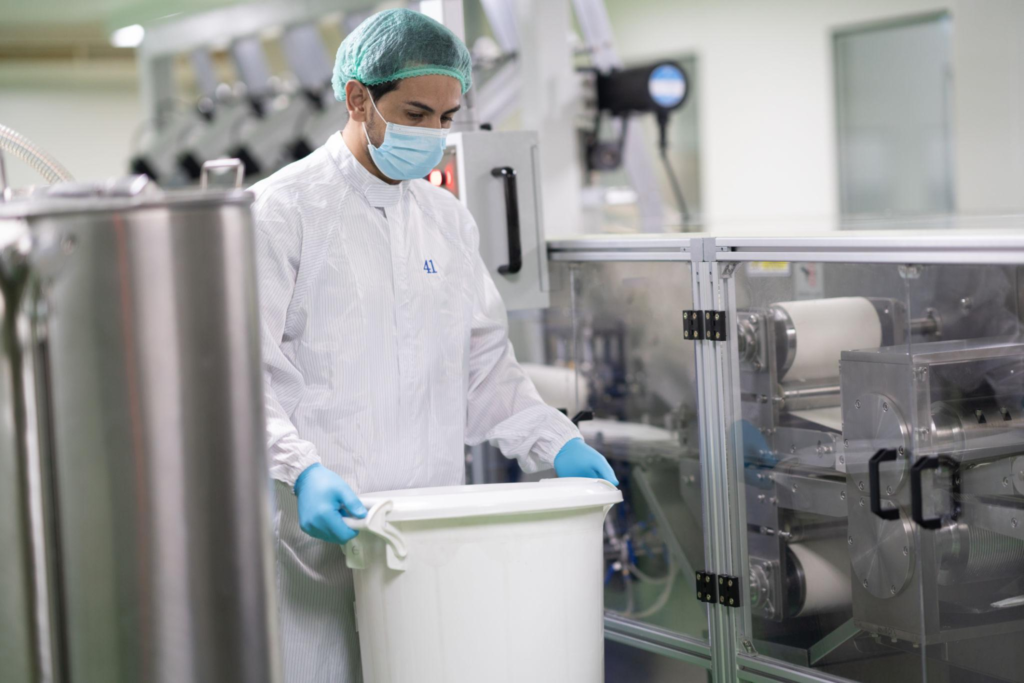
Walk into a pharmaceutical facility and the first thing you notice is how different it feels from any other workplace.
Everything is controlled. The air. The temperature. The movement of people. The materials that come in and go out. Nothing happens by accident — because in this environment, accidents have consequences.
Cleaning is no different.
A standard commercial clean — the kind that works perfectly well in an office, a hotel, or a retail unit — is completely inadequate inside a pharmaceutical facility. The reasons go deep: regulatory obligations, product integrity, patient safety, and contamination risks that simply do not exist in other settings.
This post explains exactly what makes pharmaceutical cleaning different, what GMP cleaning standards require, why cleanroom hygiene is a discipline in its own right, and why choosing the wrong cleaning contractor in this sector is a risk no facility should take.
The Stakes Are Higher in Pharmaceutical Environments
In most workplaces, a cleaning oversight causes inconvenience. A dirty desk, a smeared window, a missed bin — none of these have serious consequences.
In a pharmaceutical facility, the consequences of inadequate cleaning are in a different category entirely.
Pharmaceutical products are manufactured to be introduced into the human body — taken as tablets, injected, inhaled, or applied to skin. If contamination enters the production process, it does not just affect one surface. It can affect an entire batch of product. And if that product reaches patients, the consequences range from treatment failure to serious harm.
This is why the regulatory framework around pharmaceutical cleaning is so demanding. It is not bureaucracy for its own sake. It exists because the stakes — patient safety, product integrity, regulatory compliance — demand it.
Understanding this context is the starting point for understanding what pharmaceutical cleaning actually involves.
What Are GMP Cleaning Standards?
GMP stands for Good Manufacturing Practice. It is the system of regulations and guidelines that governs how pharmaceutical products are manufactured, tested, and controlled.
In the UK, GMP standards are set and enforced by the Medicines and Healthcare products Regulatory Agency (MHRA). For facilities that supply to the European market, EU GMP guidelines also apply. For those supplying the US market, the FDA’s Current Good Manufacturing Practice (cGMP) regulations are relevant.
All of these frameworks share a common principle: every aspect of the manufacturing environment — including how it is cleaned — must be controlled, documented, and validated.
Within GMP, cleaning is treated as a critical process. Not a support function. Not a background task. A process that must be designed, validated, and executed with the same rigour as any other step in the manufacturing operation.
What GMP Cleaning Standards Require
Written cleaning procedures. Every cleaning task in a GMP-regulated facility must have a written Standard Operating Procedure (SOP). This specifies exactly what is cleaned, how it is cleaned, what products are used, at what concentration, for how long, and by whom.
Validated cleaning methods. Cleaning methods must be validated — meaning there must be documented evidence that they actually achieve the required level of cleanliness. You cannot simply assume a method works. You must prove it.
Cleaning verification and monitoring. After cleaning, the results must be verified. This might involve visual inspection, swab testing, or bioluminescence testing to confirm that contamination has been removed to the required level.
Trained and qualified cleaning operatives. Only trained, qualified staff should carry out cleaning in GMP areas. Training must be documented and records must be kept.
Change control. If you change a cleaning product, a method, or a procedure, this change must go through a formal change control process — assessed for impact, approved, and documented before it is implemented.
Audit trails. Every cleaning activity must be recorded. Records must be accurate, complete, and available for inspection by regulatory authorities.
This level of rigour is not optional. It is what regulators expect to see when they inspect a pharmaceutical facility. And it is what our pharmaceutical cleaning services are built around.
Cleanroom Hygiene: A Discipline of Its Own
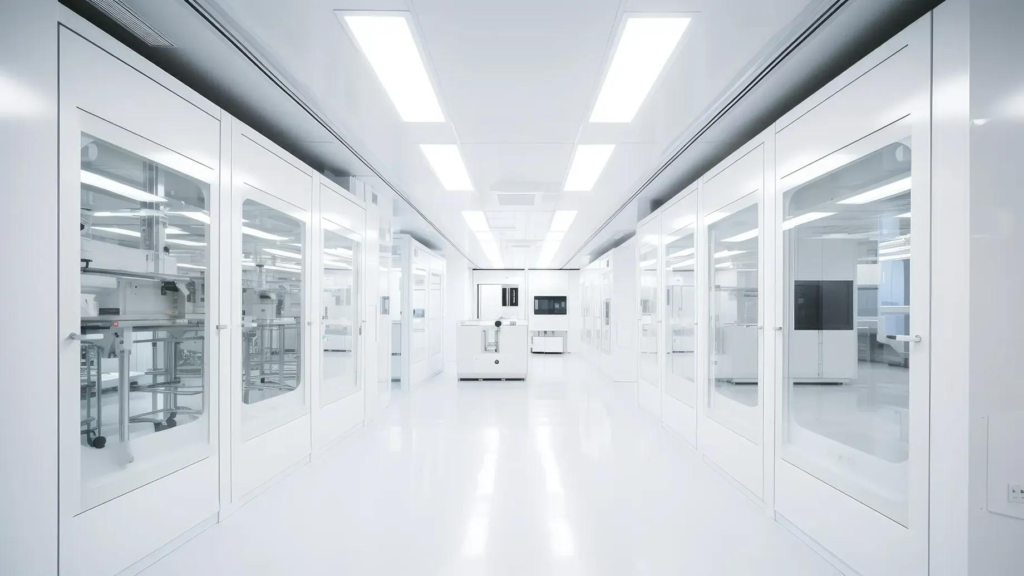
Cleanrooms are the most controlled environments in pharmaceutical manufacturing. They are rooms in which the concentration of airborne particles is controlled to specified limits, and where temperature, humidity, air pressure, and airflow are all tightly managed.
Pharmaceutical cleanrooms are classified according to ISO standards and EU GMP guidelines, ranging from ISO Class 5 (EU GMP Grade A) — the most stringent, used for the most critical operations — through to ISO Class 8 (EU GMP Grade D), used for less critical tasks.
The higher the classification, the stricter the requirements for cleanliness, particle counts, and microbial limits.
Cleaning a cleanroom is not the same as cleaning any other room. It requires a specific approach at every stage.
Entry and Gowning
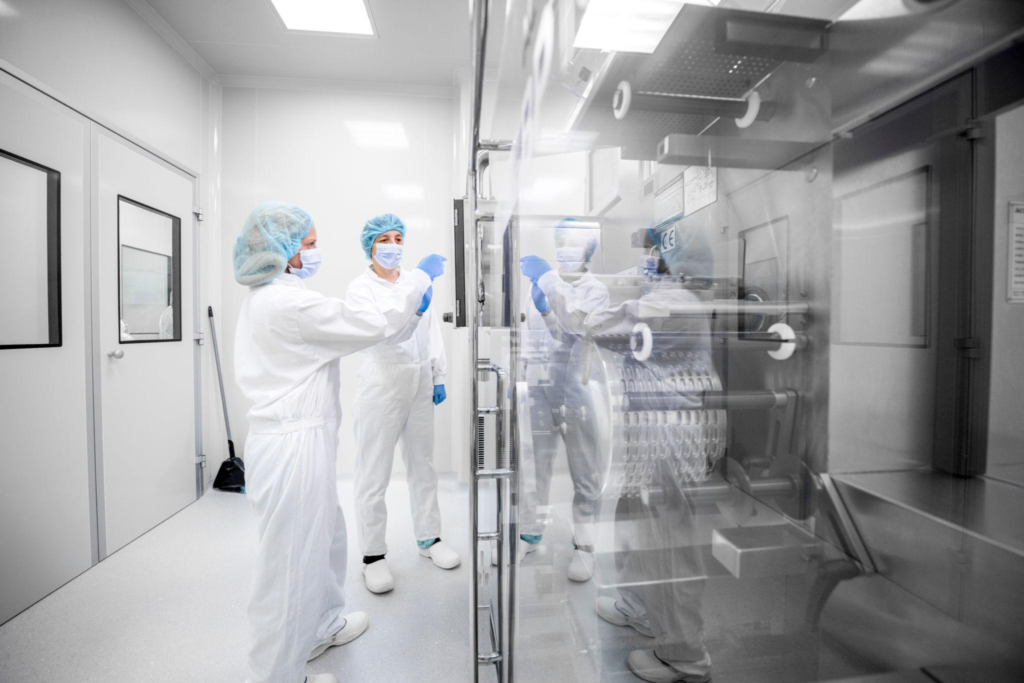
Before a cleaner enters a cleanroom, they must go through a gowning procedure — changing into cleanroom-appropriate clothing, including coveralls, gloves, face masks, and overshoes, in a defined sequence. This process exists to prevent the cleaner themselves from introducing particles or microorganisms into the environment.
Any deviation from the gowning procedure is a contamination risk. Cleaning operatives must understand this and follow it without exception.
Cleaning Sequence and Direction
In a cleanroom, cleaning must always follow a defined sequence — typically from the cleanest area to the least clean, and from high surfaces to low surfaces. This prevents contamination from being transferred to areas that have already been cleaned.
Cleaning direction matters too. Mopping, for example, must be carried out using a technique that moves contamination towards drains and away from clean zones, never spreading it across the floor.
Dedicated Equipment
All cleaning equipment used inside a cleanroom must be dedicated to that room and to the specific classification zone. Equipment used in a Grade D area must never be taken into a Grade B area. Colour-coding systems help manage this, but the underlying principle is strict physical segregation.
Equipment must also be non-particle-shedding. Standard mop heads, cloths, and brushes are not suitable inside cleanrooms. Validated, low-linting microfibre tools are the standard.
Approved Cleaning Agents
The cleaning agents used in cleanrooms must be approved for use in that environment. They must be effective against the relevant range of microorganisms, compatible with the surfaces being cleaned, and — critically — they must not themselves introduce contamination.
Many standard commercial cleaning products are not suitable for cleanroom use. They may leave residues, shed particles, or react with manufacturing materials. Only products that have been specifically validated for pharmaceutical cleanroom use should be used.
Rotation of Disinfectants
One of the less obvious requirements of cleanroom hygiene is the rotation of disinfectants. Using the same disinfectant product continuously can allow microorganisms to develop resistance over time. GMP guidelines recommend rotating between disinfectants with different mechanisms of action to prevent this.
This is a level of detail that a general cleaning contractor is unlikely to know. It is the kind of knowledge that comes from specialist training and experience in pharmaceutical environments.
Our pharmaceutical cleaning services cover all of these requirements — from gowning protocols to disinfectant rotation schedules — as standard.
The Contamination Risks That Make Specialist Cleaning Essential
To understand why specialist cleaning is so important in pharmaceutical facilities, it helps to understand the specific contamination risks that exist.
Microbial contamination. Bacteria, fungi, and other microorganisms can contaminate pharmaceutical products and cause them to fail sterility tests, degrade active ingredients, or — in the worst cases — cause infection in patients. Controlling microbial contamination requires cleaning agents and methods that genuinely kill or remove microorganisms to validated levels.
Particulate contamination. In sterile manufacturing environments, even tiny particles — dust, fibres, skin cells — can contaminate a product. This is why cleanrooms control airborne particle counts and why cleaning equipment must be low-linting and validated.
Cross-contamination. If a facility manufactures more than one product, cleaning between production runs must prevent residues of one product from contaminating the next. This is especially critical when potent active ingredients are involved — trace amounts of some pharmaceutical compounds can cause serious harm.
Chemical contamination. Residues of cleaning agents themselves can contaminate pharmaceutical products. This is why cleaning validation includes demonstrating that cleaning agents can be removed to acceptable residue limits after use.
Each of these risks requires a different approach. Managing all of them together — consistently, across an entire facility, every day — requires training, experience, and systems that go well beyond standard commercial cleaning.
Why General Cleaning Contractors Are Not Suitable
This is a point worth being direct about.
A general commercial cleaning company — however professional and reliable they may be in other settings — does not have what it takes to clean a pharmaceutical facility to GMP standard.
This is not a criticism. It is simply a matter of specialisation.
GMP cleaning requires knowledge that is not part of standard cleaning training. It requires familiarity with regulatory frameworks, cleanroom gowning procedures, validated cleaning methods, SOP documentation, disinfectant rotation, and contamination risk management. It requires operatives who understand why every step of the cleaning process matters — not just what to do, but the reason behind each requirement.
A general contractor who enters a cleanroom without the right training is a contamination risk. Their equipment may not be suitable. Their products may not be approved. Their methods may not be validated. And their documentation will not satisfy a regulatory inspector.
Pharmaceutical facilities that use non-specialist cleaners put themselves at risk of product contamination, regulatory non-compliance, failed inspections, and — ultimately — patient harm.
The right cleaning contractor for a pharmaceutical facility is one with specific experience, specific training, and a genuine understanding of the GMP environment.
At Xpect Group, our pharmaceutical cleaning services are delivered by operatives who are trained and experienced in GMP-regulated environments. We understand what is required, and we deliver it.
Beyond the Cleanroom: Other Areas of a Pharmaceutical Facility
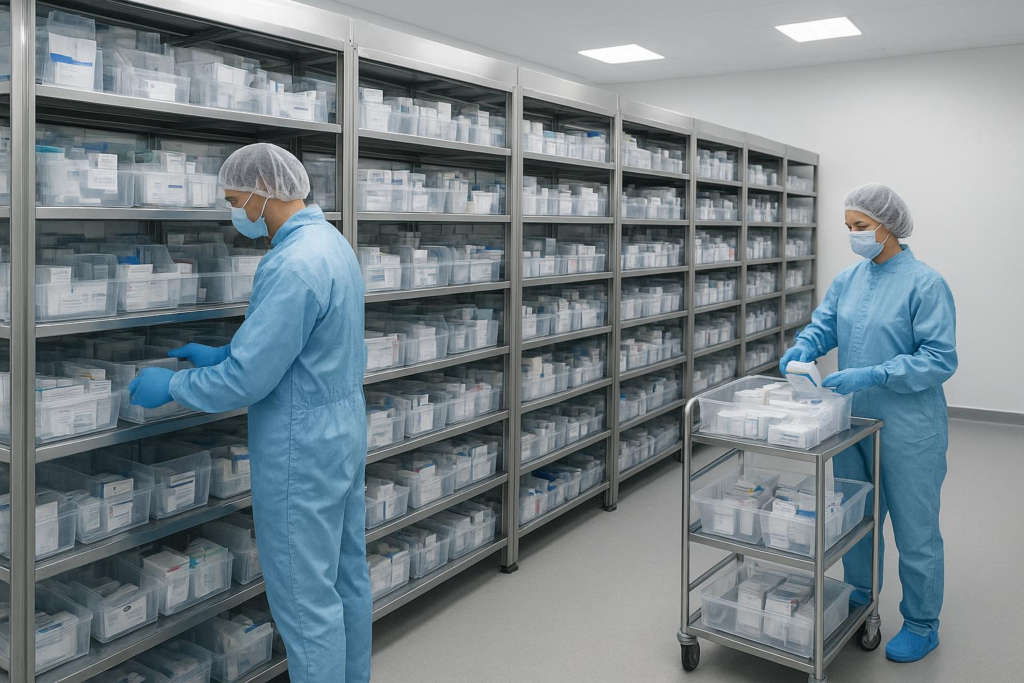
While cleanrooms attract the most attention, pharmaceutical facilities include many other areas that also require specialist cleaning.
Laboratories. Research and quality control laboratories handle chemical reagents, biological samples, and sensitive equipment. Cleaning must avoid contaminating samples, damaging equipment, and creating hazards for laboratory staff.
Warehousing and storage areas. Raw materials and finished products stored in pharmaceutical warehouses must be protected from contamination. Cleaning must be carried out without introducing dust or moisture that could compromise stored materials.
Production support areas. Corridors, airlocks, gowning rooms, and other production support areas are transition zones between clean and less clean environments. They must be cleaned to prevent contamination being carried into controlled areas.
Office and administration areas. Back-office and administration spaces within pharmaceutical facilities are less critical but must still be maintained to an appropriate standard. Dust from office areas can migrate into production zones if not managed properly.
Ourpharmaceutical cleaning services cover the full range of environments within a pharmaceutical facility — not just the cleanroom. For office and administration areas, we also offer our standard office cleaning services, ensuring that every part of your building is properly maintained.
What to Look for in a Pharmaceutical Cleaning Contractor
If you are reviewing your current cleaning provision or looking for a new pharmaceutical cleaning contractor, here is what matters.
Relevant experience. Ask specifically about experience in GMP-regulated pharmaceutical environments. References from other pharmaceutical clients are a strong indicator of genuine capability.
Trained operatives. Cleaning staff should have documented training in GMP principles, cleanroom gowning, contamination risk, and the specific procedures relevant to your facility.
Ability to work within your SOPs. Your cleaning contractor must be able to work within your existing SOPs — or work with you to develop new ones. They must understand that in a GMP environment, following the procedure is not optional.
Documentation and record-keeping. Your contractor must produce the cleaning records your QA team and regulatory inspectors will ask for. Ask to see examples.
Flexibility for audits and inspections. Regulatory inspections can happen with relatively short notice. Your cleaning contractor must be able to respond quickly, provide documentation on demand, and support you through the inspection process.
Knowledge of disinfectant validation and rotation. This is a straightforward question to ask. If a contractor cannot answer it confidently, they are not the right choice for a pharmaceutical environment.
Xpect Group: Specialist Cleaning for Pharmaceutical Facilities
At Xpect Group, we provide specialist pharmaceutical cleaning services across London and the South East. Our teams are trained in GMP requirements, cleanroom protocols, and the documentation standards that regulated facilities demand.
We understand that in pharmaceutical environments, cleaning is not a background service — it is a critical function. We treat it accordingly.
Our related services for pharmaceutical and life sciences facilities include:
- Healthcare and medical cleaning for clinical and medical environments operating under regulatory frameworks
- Office cleaning for administration and back-office areas within pharmaceutical sites
- Banking and finance cleaning for regulated financial environments with similarly demanding standards
We serve pharmaceutical facilities across London,Windsor,Epsom, and Wycombe.
Talk to Us About Your Pharmaceutical Cleaning Requirements
If your facility operates under GMP standards and you are not completely confident that your current cleaning provision meets regulatory requirements, it is worth having a conversation.
Contact Xpect Group today for a no-obligation consultation. We will take the time to understand your facility, your regulatory environment, and your cleaning requirements — and put together a programme that gives you confidence in your compliance.